
If you’ve searched online for answers about bloating, heavy periods, breast tenderness, mood swings or weight gain during perimenopause, you’ve probably encountered the term “oestrogen dominance.” It appears everywhere – on wellness websites, social media, supplements marketed to “balance your hormones,” and in alternative health circles.
But here’s what you need to know: oestrogen dominance is not a recognised medical diagnosis.
This doesn’t mean your symptoms aren’t real, or that your hormones aren’t involved. It means that the way mainstream medicine understands and treats hormonal changes is fundamentally different from how this popular term suggests.
In this article, I’ll explain why clinicians avoid the term “oestrogen dominance,” what’s actually happening in your body during perimenopause and menopause, and how it is important to take an individualised approach to hormone-related symptoms using evidence-based medicine.
1. What is “oestrogen dominance” and where did the term come from?
The term “oestrogen dominance” was popularised in the 1990s by Dr John Lee, an American physician who advocated for natural progesterone therapy. His books suggested that many women’s symptoms – from premenstrual syndrome to perimenopausal complaints – stemmed from having “too much oestrogen relative to progesterone.”
According to this theory:
- Modern life (stress, environmental toxins, diet) causes oestrogen levels to rise
- Progesterone levels fall
- This “imbalance” causes a cascade of symptoms
- Supplementing with progesterone cream or other natural remedies “rebalances” hormones
It’s an appealing, simple narrative. Unfortunately, it does not align with what peer-reviewed research tells us about how hormones actually work.
Why the term persists
Despite lacking medical recognition, “oestrogen dominance” remains popular because:
- It appears to offer a clear explanation for confusing symptoms
- It appears to give women agency over their health
- It is promoted heavily in wellness and supplement marketing
- Many women feel dismissed by conventional medicine and seek alternative frameworks
I understand the appeal. When you’re suffering and searching for answers, a clear label and solution can feel validating. But relying on non-medical frameworks can delay proper diagnosis and appropriate treatment.
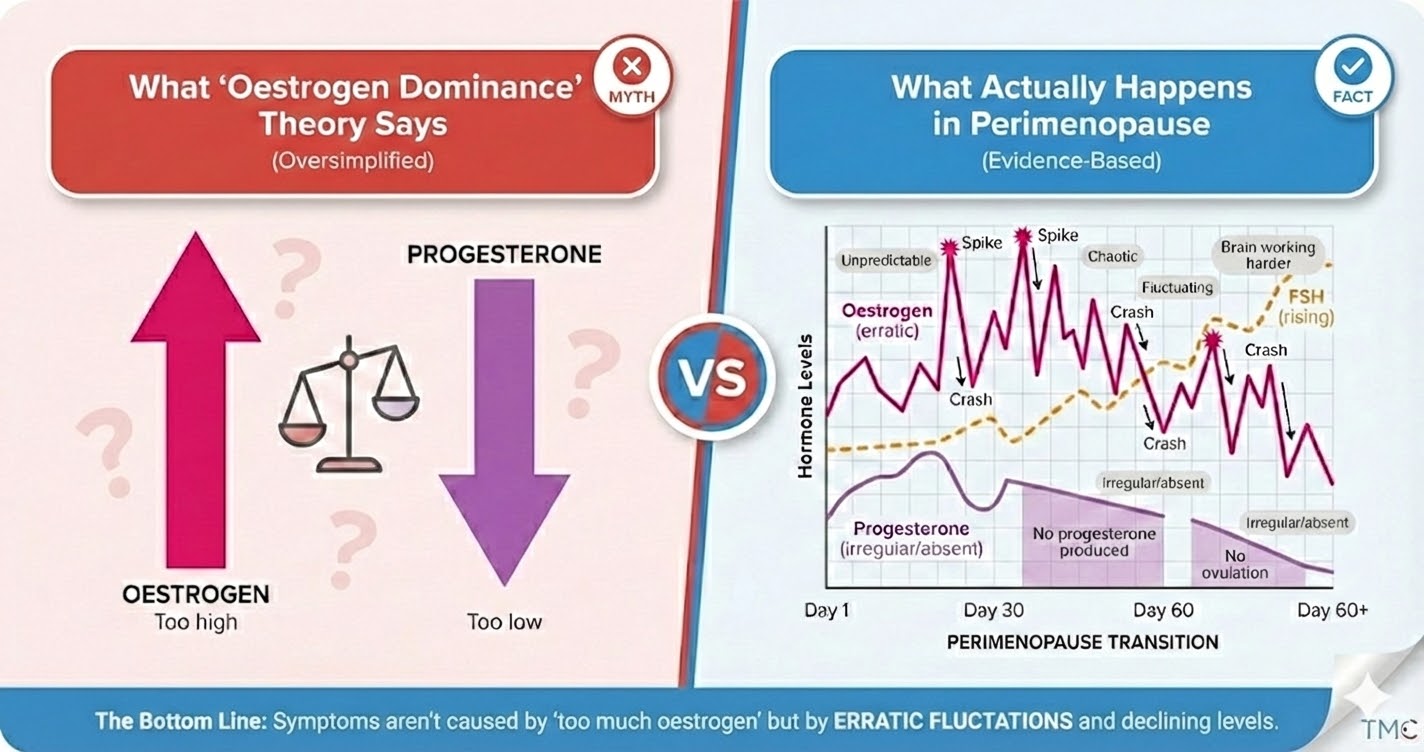
The simplified “oestrogen dominance” theory (left) versus the complex hormonal reality of perimenopause (right). Medical evidence shows erratic fluctuations, not consistently high oestrogen.
2. Why clinicians don’t use the term “oestrogen dominance”
Medical professionals avoid this term for several important reasons:
2.1 It’s imprecise and misleading
The term suggests a simple excess of oestrogen, but:
- Oestrogen levels are rarely too high in perimenopause or menopause
- In fact, during perimenopause, oestrogen fluctuates wildly – sometimes high, often low, rarely stable
- By menopause, oestrogen levels have dropped dramatically
The British Menopause Society’s 2025 consensus statement emphasises that perimenopausal symptoms arise from fluctuation and eventual decline in oestrogen, not from excess.
2.2 It oversimplifies complex hormone dynamics
Your reproductive hormones don’t work in isolation. The relationship between oestrogen, progesterone, FSH (follicle stimulating hormone), LH (luteinising hormone), testosterone and other hormones is intricate and constantly changing.
What matters clinically is:
- Which phase of reproductive life you’re in (reproductive years, perimenopause, postmenopause)
- How your hormones are fluctuating over time (not just a single snapshot)
- Your individual symptom pattern
- Your medical history and risk factors
The North American Menopause Society (NAMS) states that hormone levels vary enormously between individuals and across the menstrual cycle, making the concept of a universal “balance” medically meaningless.
2.3 Blood tests don’t support the theory
When clinicians measure hormone levels in women experiencing symptoms attributed to “oestrogen dominance,” they typically find:
- Normal or low oestrogen levels
- Variable progesterone (often low in perimenopause due to anovulatory cycles)
- Elevated FSH (showing the ovaries are working harder to produce hormones)
Research consistently shows that symptoms don’t correlate reliably with absolute hormone levels. Two women with identical blood results can have completely different symptom profiles, and two women with vastly different hormone levels can experience the same symptoms.
This is because symptom severity depends on:
- How rapidly hormones are changing
- Individual tissue sensitivity to hormones
- Receptor density and function
- Neurotransmitter interactions
- Other health factors (thyroid function, stress, sleep, inflammation)
2.4 It can delay proper diagnosis
Symptoms attributed to “oestrogen dominance” – heavy bleeding, bloating, mood changes, fatigue – could also indicate:
- Thyroid disorders
- Polycystic ovary syndrome (PCOS)
- Endometriosis or adenomyosis
- Fibroids
- Coeliac disease or food intolerances
- Iron deficiency anaemia
- Depression or anxiety disorders
- Perimenopause
Focusing on “rebalancing oestrogen and progesterone” through unregulated supplements can mean these conditions go undiagnosed and untreated.
3. What’s really happening: the perimenopause hormone transition
To understand why the “oestrogen dominance” model doesn’t fit, you need to understand what actually happens hormonally during perimenopause.
The perimenopausal pattern
A “normal” menstrual cycle is typically 28 days in length (with Day 1 being the first day of bleeding). During your reproductive years, your menstrual cycle should follow a predictable pattern:
- Follicular phase (Day 1-14 of your cycle): oestrogen rises as follicles develop
- Ovulation (Day 14): triggered by LH surge
- Luteal phase (14-28): progesterone rises from the corpus luteum (which forms as a result of ovulation) to support a potential pregnancy, oestrogen remains moderate
Menstruation then occurs on day 1-5 when both hormones drop if no pregnancy occurs.
In perimenopause, this elegant system breaks down.
As your ovarian reserve declines:
- Your brain (hypothalamus and pituitary) produces more FSH, trying to stimulate the ovaries
- Sometimes multiple follicles are recruited, causing oestrogen spikes
- Ovulation becomes irregular or absent (anovulatory cycles)
- Without ovulation, no corpus luteum forms and progesterone production plummets
- This creates cycles where oestrogen acts “unopposed” by progesterone for longer periods
The result? Erratic hormone fluctuations – not consistently high oestrogen, but unpredictable surges and drops, often with relatively low progesterone.
Professor Jerilynn Prior, a leading researcher in perimenopause, describes this as “oestrogen’s last dance” – a final period of hormonal chaos before oestrogen levels ultimately decline into menopause.
What about “unopposed oestrogen”?
You may have heard that “unopposed oestrogen” is dangerous. This is true in a specific medical context:
If you have a uterus and take systemic oestrogen therapy without adequate progesterone or progestogen, you increase your risk of endometrial hyperplasia (when the lining of the womb becomes too thick or grows in a disordered way) and cancer.
This is why women on Menopause hormone therapy (MHT) who still have a womb must take progesterone or a progestogen alongside oestrogen. (British Menopause Society)
However, this medical concept of “unopposed oestrogen therapy” is completely different from the wellness industry’s concept of “oestrogen dominance.” They are not interchangeable terms.
Top: Predictable hormone patterns in reproductive years with regular ovulation. Bottom: Chaotic perimenopausal patterns showing erratic oestrogen, absent progesterone, and rising FSH—the medical reality behind symptoms often labelled “oestrogen dominance.”
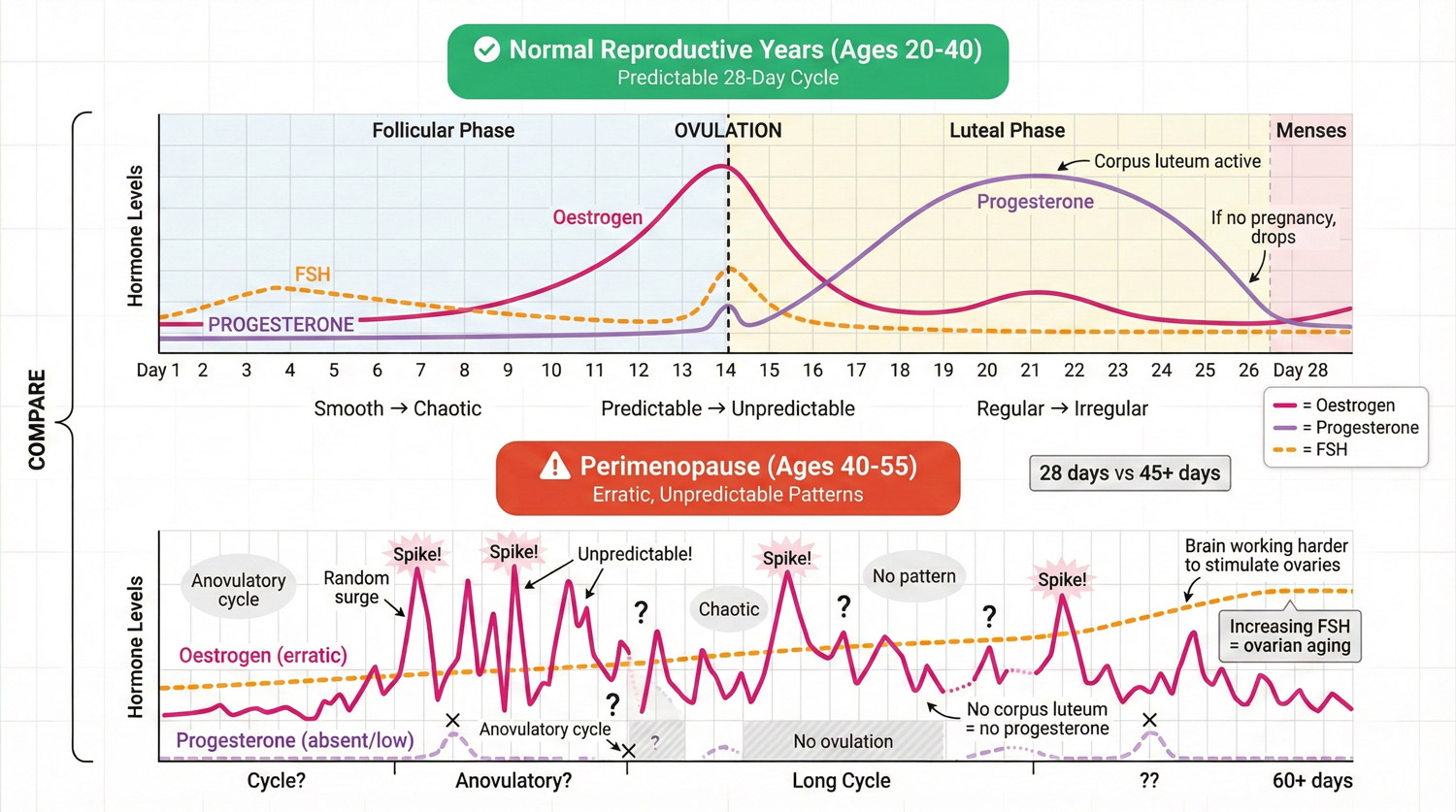
Top: Predictable hormone patterns in reproductive years with regular ovulation. Bottom: Chaotic perimenopausal patterns showing erratic oestrogen, absent progesterone, and rising FSH—the medical reality behind symptoms often labeled “oestrogen dominance.”
4. Common symptoms blamed on “oestrogen dominance” – and what’s really causing them
Let’s look at symptoms frequently attributed to “oestrogen dominance” and explain what’s actually happening from an evidence-based perspective.
4.1 Heavy or irregular periods
What you might read online: “Too much oestrogen thickens the womb lining excessively.”
What’s actually happening:
- Anovulatory cycles (no ovulation = no progesterone) allow the lining of the womb to build up without the usual progesterone-induced shedding
- This can cause heavy, irregular bleeding
- Structural problems (fibroids, polyps, adenomyosis) become more common with age and can cause heavy bleeding independent of hormone levels
- Bleeding disorders or medication effects may be involved
Medical management focuses on identifying the cause (ultrasound, endometrial biopsy if indicated) and treating with evidence-based options: hormonal contraception, tranexamic acid, the Levonorgestrel IUD (intrauterine device) e.g. Mirena coil, or MHT with adequate progesterone protection.
4.2 Bloating and fluid retention
What you might read online: “Excess oestrogen causes water retention.”
What’s actually happening:
- Oestrogen fluctuations can affect fluid balance, but so can progesterone
- Many women feel more bloated pre-menstrually when both hormones are present
- Bloating is often multifactorial: diet, gut health, food intolerances, stress, changes in digestion with age
- Some women develop IBS (irritable bowel syndrome) symptoms during perimenopause due to changes in gut motility influenced by hormones
Assessment should include dietary triggers, gut health evaluation, coeliac screening if indicated, and consideration of how hormones might be affecting gut function.
4.3 Breast tenderness
What you might read online: “High oestrogen causes painful, swollen breasts.”
What’s actually happening:
- Breast tissue is sensitive to both oestrogen and progesterone
- Cyclical mastalgia (breast pain) is common in perimenopause due to hormonal fluctuation
- Sudden changes in hormone levels (up or down) can trigger breast tenderness
Treatment might include well-fitted bras, evening primrose oil (limited evidence but some women find it helpful), and occasionally medication like danazol in severe cases.
More on menopause, from our specialists
One email a month: new articles written by the clinicians you’d see. No spam, unsubscribe anytime.
4.4 Mood swings, anxiety, low mood
What you might read online: “Too much oestrogen makes you emotional and anxious.”
What’s actually happening:
- Rapidly fluctuating oestrogen affects neurotransmitters (serotonin, GABA, dopamine)
- The rate of change matters more than absolute levels
- Declining oestrogen in perimenopause increases vulnerability to depression and anxiety
- Sleep disruption from night sweats worsens mood
- Life stressors often coincide with perimenopause (aging parents, teenage children, career demands)
Research shows that perimenopausal and early postmenopausal women have a 2-4 times higher risk of depression compared with their premenopausal years, linked to hormone fluctuation rather than excess. (JAMA Psychiatry)
Treatment may include lifestyle changes, psychological therapies, stress management, addressing sleep, MHT (oestrogen stabilises mood for many women), and antidepressants if clinically indicated.
4.5 Weight gain, especially around the middle
What you might read online: “Oestrogen dominance causes stubborn belly fat.”
What’s actually happening:
- Declining oestrogen (not excess) is associated with redistribution of fat to the abdomen
- Metabolic rate slows with age
- Muscle mass naturally declines (sarcopenia) unless you do resistance training
- Insulin sensitivity may decrease
- Sleep disruption affects appetite hormones (ghrelin, leptin)
The Women’s Health Initiative and subsequent studies have shown that women on MHT often have less visceral fat gain compared with untreated women, suggesting oestrogen deficiency contributes to weight distribution changes. (PubMed)
4.6 Fatigue and “brain fog”
What you might read online: “Too much oestrogen slows metabolism and makes you tired.”
What’s actually happening:
- Poor sleep quality from night sweats and hormonal sleep disruption
- Oestrogen affects mitochondrial function and energy production
- Thyroid function changes are common in midlife and cause fatigue
- Iron deficiency may have resulted from heavy periods
- Vitamin D deficiency
- Stress and mood disorders
Proper assessment includes thyroid function tests, full blood count, ferritin, vitamin D, vitamin B12, folate and consideration of sleep quality and mental health.
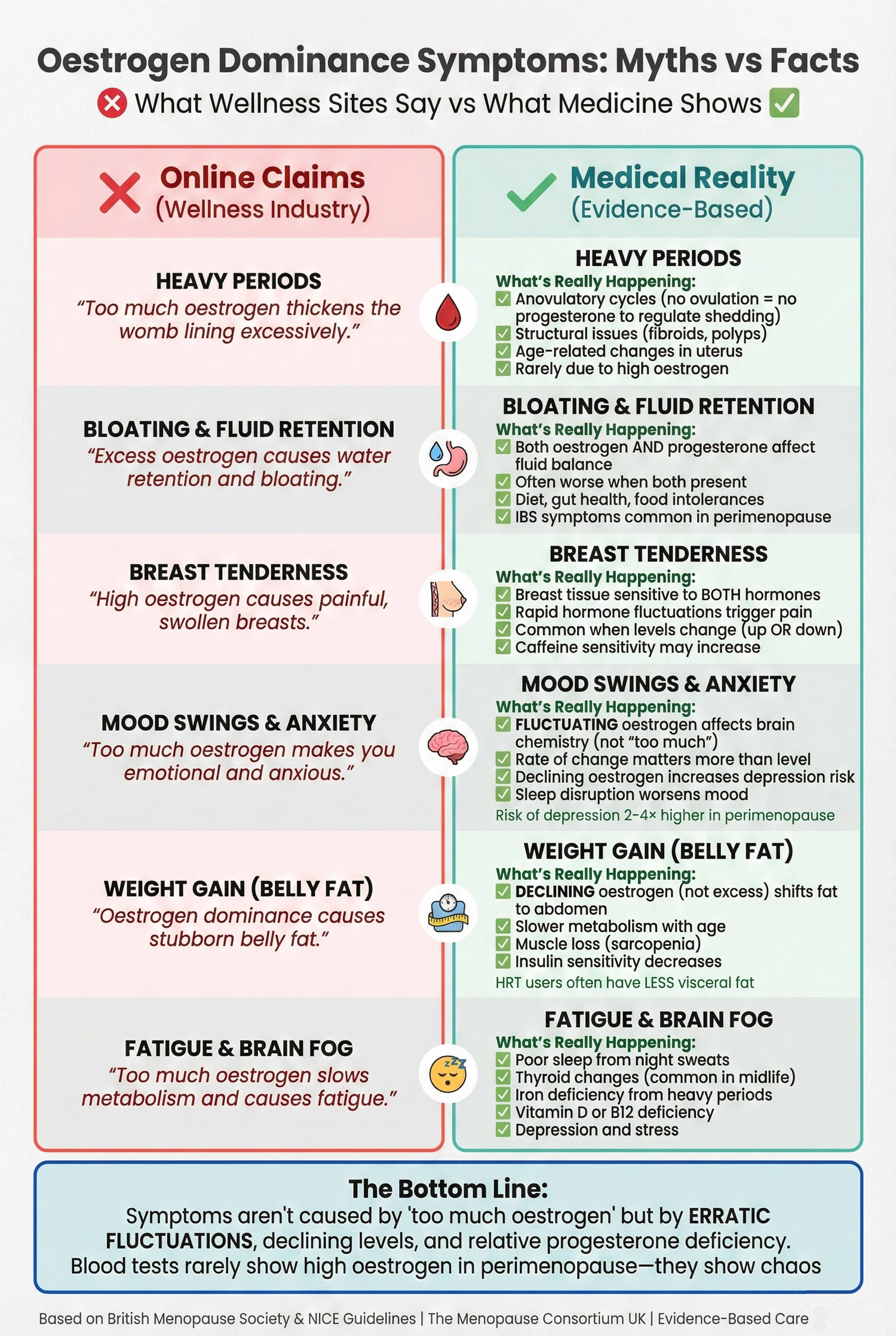 What wellness websites claim about “oestrogen dominance” symptoms versus what medical science actually shows. The reality is more complex and more treatable than online myths suggest.
5. What medical tests actually show
5.1 Why hormone blood tests are limited in perimenopause
Many women request blood tests to “check their hormone levels” and expect clear answers. Unfortunately, hormone testing in perimenopause is notoriously unhelpful.
Here’s why:
- Hormone levels fluctuate dramatically day-to-day and even hour-to-hour
- A single blood test is just a snapshot of a constantly changing picture
- There’s no “normal” range for perimenopause
- Symptoms correlate poorly with hormone levels
The British Menopause Society advises that perimenopause is a clinical diagnosis based on symptoms and menstrual pattern, not blood tests. FSH can however be helpful in women under 45 to confirm early menopause.
5.2 When tests are useful
Hormone and other blood tests are valuable to:
- Rule out other conditions (thyroid disorders, anaemia, coeliac disease)
- Check FSH in women under 40 with menopausal symptoms (premature ovarian insufficiency)
- Monitor specific treatments
- Assess cardiovascular and bone health risk factors
5.3 The problem with saliva and urine hormone tests
Many alternative practitioners offer saliva or urine hormone testing, claiming these give more accurate “free” hormone levels.
These tests are not validated for diagnosing hormone imbalance.
They:
- Have no standardised reference ranges
- Show even more variation than blood tests
- Are not used in evidence-based medicine
- Often lead to inappropriate treatment recommendations
The Endocrine Society and major menopause societies do not recommend saliva or urine testing for hormone assessment.
6. The real culprits: what doctors look for instead
When you present with symptoms attributed online to “oestrogen dominance,” here’s what evidence-based clinicians actually assess:
6.1 Menstrual pattern changes
In perimenopause, the real issue is often due to hormonal fluctuations leading to anovulatory cycles, not sustained high oestrogen. This can cause:
- Heavy, prolonged bleeding
- Shorter cycles
- Breast tenderness
- PMS-like symptoms
Possible treatment options: Hormonal contraception, Levonorgestrel IUD, or combined MHT when appropriate.
6.2 Thyroid dysfunction
Thyroid disorders affect 1 in 8 women and are easily missed. Symptoms related to an underactive thyroid particularly overlap with “oestrogen dominance”:
- Weight gain
- Fatigue
- Low mood
- Brain fog
- Heavy periods
Essential tests: TSH, free T4, and thyroid antibodies if indicated.
6.3 Structural uterine problems
- Fibroids: Very common (up to 70% of women by age 50); cause heavy bleeding, pressure, bulk symptoms
- Adenomyosis: Endometrial tissue grows into the uterine muscle wall; causes painful, heavy periods
- Endometrial Polyps: A growth in the inner lining of the womb (usually noncancerous): can cause irregular bleeding
Diagnosis: Pelvic ultrasound, hysteroscopy or sometimes MRI.
6.4 Iron deficiency and anaemia
Heavy periods deplete iron stores, causing:
- Fatigue
- Brain fog
- Breathlessness
- Palpitations
Often dismissed as “just hormones” when actually treatable with iron replacement.
6.5 Other hormonal conditions
- PCOS: Can occasionally present in perimenopause with irregular cycles, weight gain, mood changes
- Insulin resistance: Common in midlife; contributes to weight gain, energy crashes
- Cortisol fluctuations: Chronic stress affects all hormones
7. Evidence-based approaches to hormonal symptoms
So if “oestrogen dominance” isn’t the answer, what is? Here’s how modern medicine approaches hormonal symptoms:
7.1 Individualised assessment
No two women’s hormonal transitions are the same. A thorough assessment includes:
- Detailed symptom diary (tracking patterns over 2-3 months)
- Menstrual history
- Medical and family history
- Physical examination where appropriate
- Targeted investigations (not routine hormone panels)
7.2 Treating the actual problem
For perimenopausal symptoms (hot flushes, night sweats, mood, sleep):
- Healthy lifestyle choices: a heart healthy diet, regular exercise and avoiding caffeine and alcohol are a good place to start
- Menopause Hormone Therapy): Very effective treatment
- Oestrogen (patch, gel, spray, or tablet) for symptoms
- Progesterone or progestogen if you have a womb for endometrial protection
- Non-hormonal options: Cognitive behavioural therapy (CBT), mood stabilisers such as SSRIs (selective serotonin reuptake inhibitors) and SNRIs (serotonin-norepinephrine reuptake inhibitors), Gabapentin,or Fezolinetant (NK3 receptor antagonist)
For heavy or irregular bleeding:
- Levonorgestrel-IUD (intrauterine device): Highly effective, also provides contraception and endometrial protection for MHT users
- Tranexamic acid: Reduces bleeding by 40-50%
- Progesterone only or combined hormonal contraception: Regulates cycles in perimenopause
For mood and anxiety:
- MHT can help if symptoms are linked to hormonal fluctuation
- Antidepressants: Evidence-based for perimenopausal depression
- Psychological support: CBT, mindfulness
- Sleep optimisation: Often transformative
For weight and metabolic changes:
- MHT may help with fat distribution and insulin sensitivity
- Resistance training: Essential to maintain muscle mass
- Protein intake: 0.75g per kg body weight for general adults
- Mediterranean-style diet: Anti-inflammatory benefits
- Sleep and stress management: Affect cortisol and appetite hormones
7.3 Addressing lifestyle foundations
While not a cure-all, these genuinely help:
- Regular movement: 150 minutes moderate activity weekly plus resistance training
- Nutrional adequacy: Focus on whole foods, adequate protein, healthy fats
- Sleep hygiene: Consistent schedule, cool bedroom, wind-down routine
- Stress management: Whatever works for you (yoga, meditation, therapy, hobbies)
- Alcohol moderation: Alcohol can worsen hot flushes, sleep, mood, breast cancer risk
- Smoking cessation: Smoking can accelerate menopause, worsen symptoms
7.4 When to see a specialist
Seek specialist menopause care if:
- Your GP is unfamiliar with individualised MHT
- You have complex medical history (breast cancer, cardiovascular disease, clotting disorders)
- Standard treatments have not helped
- You’re experiencing severe mood or mental health symptoms
- You’re under 40 with menopausal symptoms
8. The supplement industry and “oestrogen dominance”
8.1 Why supplements are marketed for “hormone balance”
The wellness industry thrives on “oestrogen dominance” because:
- Supplements do not require prescription or medical supervision
- Marketing can make claims not subjected to pharmaceutical regulation
- It taps into women’s frustration with conventional medicine
- Creates a recurring customer base
8.2 Common supplements marketed for “oestrogen dominance” and what evidence says
DIM (Diindolylmethane):
- Marketed to “metabolise excess oestrogen”
- Limited human studies; theoretical mechanism only
- No evidence for symptom relief in menopause
- Can interfere with thyroid medication
Calcium D-Glucarate:
- Claimed to “eliminate excess oestrogen”
- No clinical trials supporting efficacy
- Theoretical benefit only
Progesterone creams:
- Over-the-counter creams contain inconsistent doses
- Absorption through skin is unpredictable
- Not regulated or standardised
- Can’t provide reliable endometrial protection
“Hormone balancing” herbal blends:
- Usually contain combinations of black cohosh, vitex, dong quai, etc.
- Variable quality and dosing
- Little evidence for most; some may help hot flushes mildly (black cohosh)
- Can interact with medications and may not be suitable depending on co-morbidities
8.3 The problem with self-treatment
Treating perceived “oestrogen dominance” with unregulated supplements:
- Delays proper diagnosis of treatable conditions
- Wastes money (many supplements cost £30-60+ monthly)
- Can cause side effects or medication interactions
- Misses opportunity for effective evidence-based treatment
9. How to talk to your doctor about your symptoms
If you’ve been reading about “oestrogen dominance” and are concerned about your symptoms, here’s how to have a productive conversation with your clinician:
What to bring:
- Symptom diary (2-3 months) including menstrual pattern
- List of all symptoms with impact on daily life
- Previous blood tests if available
- List of supplements/medications you’re taking
- Family history of relevant conditions
Questions to ask:
- “Could my symptoms be related to perimenopause?”
- “What conditions should we rule out?” (thyroid, anaemia, structural problems)
- “Would MHT be appropriate for me?”
- “What are my options for managing [specific symptom]?”
- “What investigations would you recommend?”
What to avoid:
- Diagnosing yourself with “oestrogen dominance”
- Requesting unnecessary hormone panels
- Expecting supplements to be recommended
- Being dismissive of evidence-based treatments
If your doctor isn’t helpful:
- Ask for referral to a menopause specialist
- Check British Menopause Society database for trained clinicians
- Consider a specialist women’s health clinic (like TMC Health)
10. Key take-home messages
- “Oestrogen dominance” is not a medical diagnosis. It’s a wellness industry term that does not reflect how hormones actually work in perimenopause and menopause.
- Oestrogen levels are rarely too high in midlife. Symptoms arise from erratic fluctuation and eventual decline.
- Blood tests are limited for diagnosing perimenopause. Clinical assessment based on symptoms and menstrual pattern is more reliable.
- Your symptoms are real and deserve proper investigation. Don’t let focus on “oestrogen dominance” delay diagnosis of thyroid disorders, anaemia, structural uterine problems, or other treatable conditions.
- Evidence-based treatments work. MHT is highly effective for menopausal symptoms but there are many other options available to you depending on what appears to be the cause of your symptoms.
- Individualised care matters. Every woman’s hormonal transition is different. Work with a menopause-literate clinician to find what works for you.
- Unregulated supplements marketed for “hormone balance” have little evidence behind them and can delay proper treatment.
- Lifestyle foundations can help
11. Clinical guidance and expert voices
To ensure your care is grounded in robust evidence, your clinician may refer to:
- British Menopause Society & Women’s Health Concern HRT recommendations (updated 2025) – comprehensive guidelines on diagnosis and management
- North American Menopause Society 2022 Hormone Therapy Position Statement – led by Dr Stephanie Faubion, emphasises evidence-based hormone therapy
- NICE Menopause Guidelines (NG23, updated 2024) – UK-specific evidence-based recommendations
- International Menopause Society position statements – global consensus on menopause management
- Jerilynn Prior’s perimenopause research – Canadian researcher highlighting progesterone deficiency in perimenopause
- Hadine Joffe’s work on mood and menopause – Harvard researcher on depression in menopause transition
Further reading & resources
You can explore these evidence-based resources:
- British Menopause Society
- North American Menopause Society
- TMC Health
- Menopause Matters
- Balance Menopause Support
Related articles from TMC Health:
- Progesterone Intolerance: Alternatives and Management for Menopause HRT
- Understanding Breakthrough Bleeds on Menopause Hormone Treatment
- Navigating Menopause: Understanding Weight Gain and Prioritizing Health
- Psychological Menopause Symptoms
- PMS and PMDD in Perimenopause
Disclaimer
Disclaimer: This article is for general information about hormonal health and menopause care. It does not replace personalised medical advice. Always discuss your symptoms and treatment options with a qualified health professional familiar with your medical history.
If you believe you’re experiencing perimenopausal or menopausal symptoms, please book a consultation with a menopause-trained clinician who can provide individualised assessment and evidence-based care.
About TMC UK
TMC provides specialist, evidence-based menopause care across multiple UK clinics and online. Our menopause-trained clinicians offer:
- Comprehensive symptom assessment
- Individualised MHT prescribing
- Complex case management
- Second opinions
- Holistic support for all aspects of hormonal health
We believe every woman deserves access to high-quality, personalised menopause care based on the latest medical evidence – not wellness myths.
Book an appointment | Find your nearest clinic